"AI Workflows" Is an Oxymoron. If It's Truly AI, Call It What It Is: A Decision Flow.
By Bhupesh Naik ·
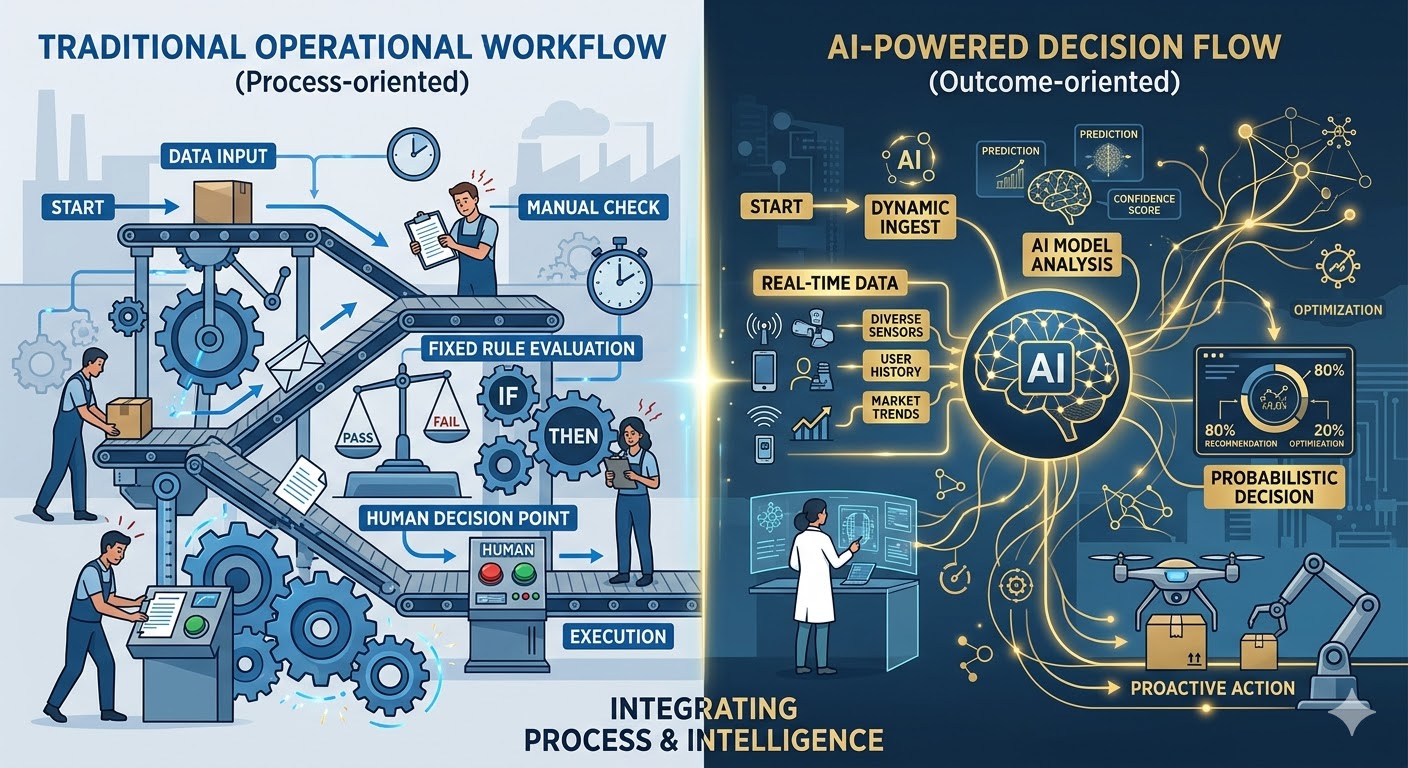
The term "AI Workflows" has become ubiquitous in enterprise technology. It appears in every platform pitch, every vendor demonstration, and every conference keynote. The assumption seems to be that prefixing "AI" to a concept from the 1990s somehow makes it intelligent.
It does not. And I would argue the term is doing real damage to how the industry thinks about agentic AI.
There is an obvious contradiction hiding in plain sight
A workflow, by definition, is a sequence of work. Repeatable tasks arranged in a predetermined order. It is assembly-line thinking expressed in BPMN diagrams and Swimlane charts. This model made perfect sense when humans needed coordination: who does what, when, and in what order.
But work, as in repetitive, predictable task execution, is precisely what AI should be eliminating, not automating.
That is the entire promise of this technology. Not to perform work faster. To make the work disappear altogether.
The term "AI Workflow" therefore amounts to saying: "Let us use intelligence to follow a script." It is the equivalent of hiring a strategist to perform data entry, pointing the most powerful technology of our generation at the least valuable part of any process.
When we design systems where "Agent A completes step 1, Agent B completes step 2, and a human reviews at step 3," we are not building intelligence. We are building elaborate automation with a language model attached.
The real unit of value is not work. It is a decision.
Consider what genuinely matters in any business process. It is not the tasks themselves. It is the decisions between the tasks.
Should this loan be approved? Is this counterparty creditworthy? Does this contract clause introduce unacceptable risk? Should this case be escalated, or can it be resolved automatically?
These cognitive decisions are where all the value resides. The tasks surrounding them, retrieving data, formatting reports, dispatching emails, updating records, are plumbing. They are precisely what should disappear.
Rather than "AI Workflows," the industry should be designing Decision Flows.
What is a Decision Flow?
A Decision Flow is not a sequence of tasks. It is a sequence of cognitive decisions, each informed by context, governed by policy, and executed with judgement.
In a traditional workflow, the process might read:
– Collect documents. Verify identity. Check credit score. Generate report. Send to underwriter. Await approval.
In a Decision Flow, the same process becomes:
– Decide: Is this applicant who they claim to be?
– Decide: What is the genuine risk profile?
– Decide: Does this fit within appetite and policy?
– Decide: Approve, decline, or refer, and on what basis?
The distinction is significant. The first is a task list. The second is reasoning.
This is what agentic AI should be doing. Not following a script, but making decisions, each one contextual, each one reasoned, each one auditable.
Why this distinction matters for Agentic AI
When organisations design around "AI Workflows," they build systems that mimic human busywork. They automate the motions without automating the thinking.
When they design around Decision Flows, three things change:
1. Work is eliminated, not automated
When an AI agent can make a decision, the surrounding tasks largely evaporate. There is no need for a separate "data gathering step" if the agent already knows where to look and what is material. The decision becomes the process.
2. Explainability emerges by design
A Decision Flow is inherently auditable. Every node is a decision with defined inputs, documented reasoning, and a clear outcome. In regulated industries such as banking, this is not merely good practice, it is a compliance requirement. Consider the difference between explaining a 47 step workflow to a regulator versus presenting a clear chain of five decisions with documented rationale.
3. The system is designed for judgement, not just execution
Workflows assume the path is predetermined. Decision Flows assume the path depends on context. This is a fundamental shift. It means AI agents are not merely following instructions. They are navigating uncertainty, weighing trade offs, and arriving at reasoned conclusions. That, in essence, is what "agentic" means.
The label shapes the architecture
This is not a pedantic argument about terminology. The label we apply to something frames how teams think about it, and how they think determines what they build.
Tell a team to "build an AI Workflow," and they will produce a pipeline. Steps in, steps out. The same process, marginally faster. The paperwork has been automated; the thinking has not.
Tell a team to "design a Decision Flow," and they will build something that reasons. They will ask: which decisions are being made? What context is required? What policies apply? What is the confidence threshold? When should a human be in the loop, not because the task cannot be automated, but because the decision warrants human judgement?
That yields a fundamentally different product, a fundamentally different architecture, and a fundamentally different value proposition.
The bottom line
We are in the early stages of agentic AI, and there is already a risk of thinking too small, not because the technology lacks capability, but because the industry keeps reaching for familiar labels.
"AI Workflow" is a comfortable label. It reassures stakeholders that the process is unchanged, just faster. But that comfort is a trap. It keeps organisations optimising tasks that should not exist, rather than designing the cognitive architecture that creates genuine value.
"Decision Flow" is the more demanding label. It forces harder questions: which decisions actually matter? What context do they require? What policies govern them? It centres on cognition, designs for judgement, and treats AI not as a faster pair of hands, but as a reasoning engine.
The next time someone presents an "AI Workflow," it is worth asking: where are the decisions?
If they cannot point to them clearly, what you are looking at is not AI. It is automation with a more sophisticated veneer.
"AI Workflow" is an oxymoron. The era of automating work is ending. The era of automating decisions has begun.