The Forward Deployed CxO in the AI Era
By Bhupesh Naik ·
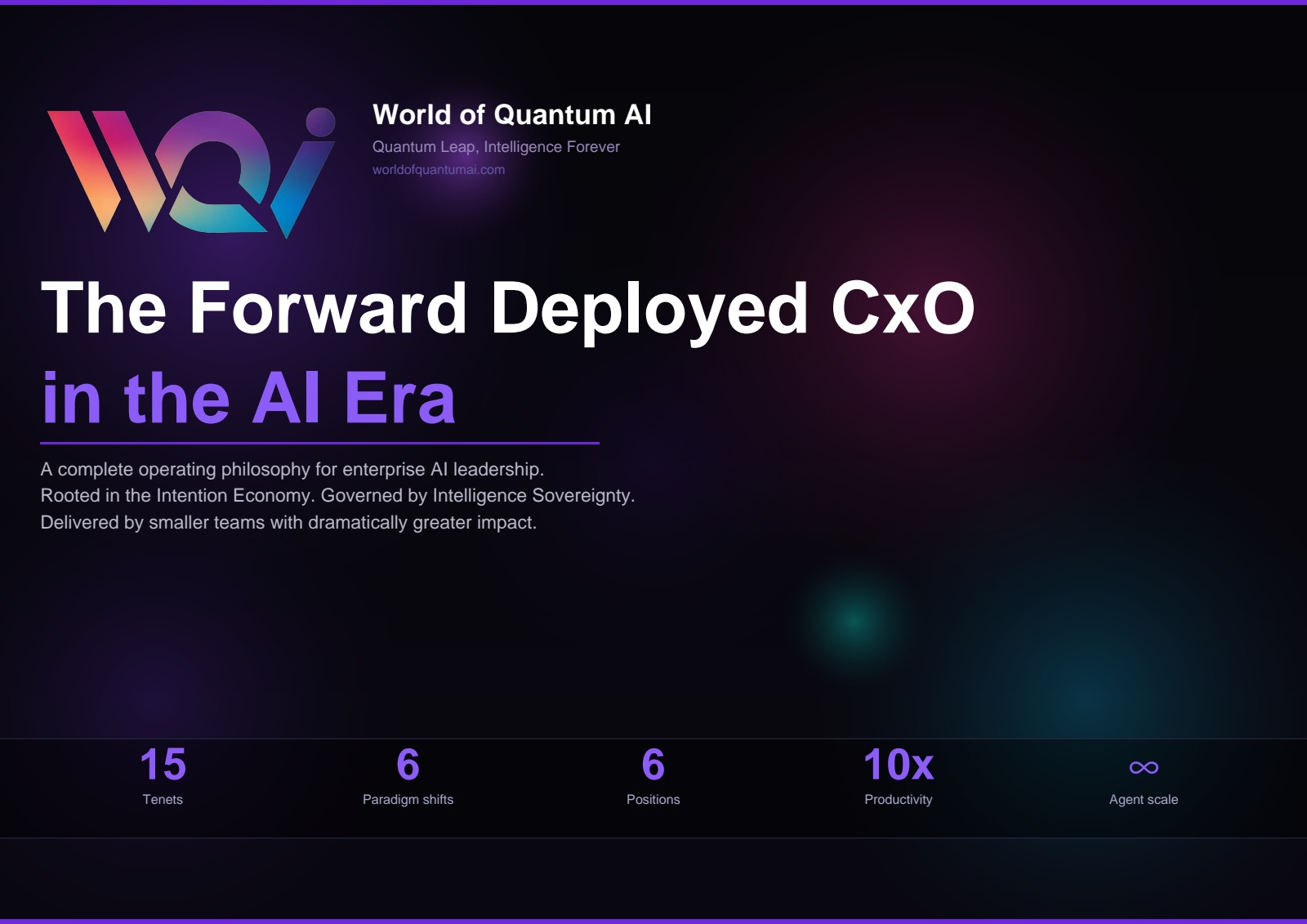
The Forward Deployed CxO (FD-CxO) is not a title — it is a complete operating philosophy for enterprise AI leadership. Rooted in the Intention Economy, governed by Intelligence Sovereignty, and delivered by smaller teams with dramatically greater impact.
Six Paradigm Shifts Shaping the Intelligence Era
From Attention to Intention
The Attention Economy was the defining commercial logic of the digital age. Platforms competed to capture eyes, hold them longer, and monetise the resulting behaviour regardless of whether the user was better off for the engagement.
The Intention Economy inverts that logic entirely. It asks, as its founding principle: whose intent does this serve? Agentic AI is the first technology in history capable of making this architecturally achievable at enterprise scale — an AI that genuinely acts on behalf of the person, not the platform.
From Headcount to Agent-Amplified Teams
The traditional logic of enterprise delivery assumed a direct relationship between input and output: more people meant more work delivered. This is no longer true.
A team of ten, properly composed and orchestrated with agents, consistently outperforms a traditional team of seventy. This is not aspiration — it is the economic proof the FD-CxO delivers personally through how they operate.
From SaaS Economics to Intelligence Economics
Per-seat, per-feature subscription models were designed for a world where software augmented human workers. When agents can perform those tasks, the per-seat model loses its economic logic entirely.
Intelligence economics operates differently. The cost structure is high fixed and near-zero marginal — the opposite of labour economics. The first client engagement bears the full build cost; every subsequent engagement costs almost nothing more.
From Data Storage to Knowledge Harvesting
Organisations have spent decades accumulating data in systems of record and warehouses. Most of this data is passive, backward-looking, and structurally inert. It describes what happened — it does not encode why decisions were made.
Knowledge Harvesting is the deliberate conversion of tacit institutional expertise into structured AI training capital. Every engagement deepens the domain model, deepens the value delivered, and deepens the switching cost that protects the long-term relationship.
From Feature Moats to Domain AI Moats
Software features can be copied. Methodology can be reverse-engineered. The moats that protected technology businesses are fundamentally weaker in the intelligence era.
The new moat is a fine-tuned domain AI model trained on proprietary expert judgment and sector-specific data. This cannot be replicated without the underlying data and the years of engagement required to generate it. It compounds with every use.
From Productivity Tool to Intelligence Sovereignty
Using AI to do tasks faster is a productivity play. When AI begins to shape decisions — credit assessments, risk analysis, strategic planning — the question of who controls that AI becomes a governance and fiduciary question.
Six Defining Stances of the FD-CxO
1. Intention Architect — Designs every AI system around the user's declared intent, not the platform's commercial agenda or the vendor's model roadmap.
2. Sovereignty Champion — Protects the client's fundamental right to own, govern, and direct the intelligence that shapes their business. Model ownership, data governance, and audit trail integrity are non-negotiable from day one.
3. Knowledge Harvester — Converts tacit institutional expertise into proprietary AI capital that compounds with every engagement. The most valuable asset in any organisation is not its data, but the expert reasoning applied to that data.
4. New Economics Operator — Models and operates entirely in AI-era economics: high fixed cost, near-zero marginal, outcome-priced, agent-scaled.
5. IP Builder — Constructs domain AI models and sector-specific reasoning frameworks that function as the primary strategic moat.
6. Responsible AI Champion — Makes trust, explainability, and ethical governance the commercial differentiator embedded from the beginning of every deployment.
The Operating Model: Hands-on Partnership, Human Advantage, and the 10x Team
The FD-CxO does not delegate discovery. They build the first agent, run the first prompt, analyse the output, diagnose the failure modes, and redesign the workflow. When the FD-CxO says "I ran this on your data," the conversation changes entirely.
Human Advantage treats the specific judgment, creativity, ethical navigation, and domain context of each individual as a strategic asset that compounds in value as agents take over execution tasks.
A team of ten, composed on this basis, carries the strategic and delivery load of a traditional practice of seventy — not because the ten work harder, but because the agents they orchestrate work continuously, without error accumulation, without handoff delay, and at the cost of compute rather than human hours.
The Fifteen Tenets
The FD-CxO framework is built on fifteen tenets spanning five pillars:
Pillar 1 — Strategic Foundation
– Intention-First Design — Every AI deployment begins with whose intent it serves
– Sovereignty by Default — Model ownership and data governance from day one
– Knowledge as Capital — Expert reasoning converted into compounding AI assets
Pillar 2 — Commercial Architecture
– Outcome Economics — Pricing tied to value delivered, not hours worked
– IP Compounding — Every engagement leaves behind a smarter model
– Agent-Amplified Delivery — Smaller teams with dramatically greater impact
Pillar 3 — Client Partnership
– Hands-On Build — Demonstrated capability, not asserted expertise
– Co-Ownership — Shared investment in shared outcomes
– Independence by Design — Clients who don't need you are clients who choose you
Pillar 4 — People and Organisation
– Human Advantage — Roles redesigned around what agents cannot do
– Judgment Concentration — Human effort focused on irreplaceable contributions
– Continuous Learning — People who grow faster than the technology they use
Pillar 5 — Trust and Governance
– Responsible AI First — Ethics embedded from the beginning, not retrofitted
– Explainability as Standard — Every AI decision can be understood and challenged
– Regulatory Readiness — Compliance as architecture, not afterthought
The FD-CxO is not a new management framework. It is a complete operating philosophy for the intelligence era — one that treats every engagement as an opportunity to demonstrate that smaller teams with better judgment, proper agent orchestration, and genuine client partnership can deliver outcomes that traditional models cannot match at any headcount.