The Magic Word “Quantum” – What It Actually Means
By Mitansh Naik ·
By Mitansh Naik · info@worldofquantumai.com
In 1900, Max Planck wanted to explain why hot objects glow the way they do, which led to the proposition that energy is exchanged in tiny packets called ‘quanta’. More than a century later John Clarke, Michel Devoret and John Martinis won the 2025 Nobel Prize in Physics for showing that quantum tunnelling and quantised energy levels appear in an electrical circuit you could hold in your hand. In the space between those two moments, the term ‘quantum’ drifted from a precise technical term to a word that stands for anything mysterious or futuristic and nobody stretches the word further than headlines and Hollywood. From computers that try every answer at once to messages that travel faster than light, quantum can seemingly do it all. Some of what is claimed pure invention, some is a distorted echo of real physics, and some is closer to the truth than you would expect, so let’s sort one from the other.
01. ‘A quantum computer tries every answer at once’: Busted
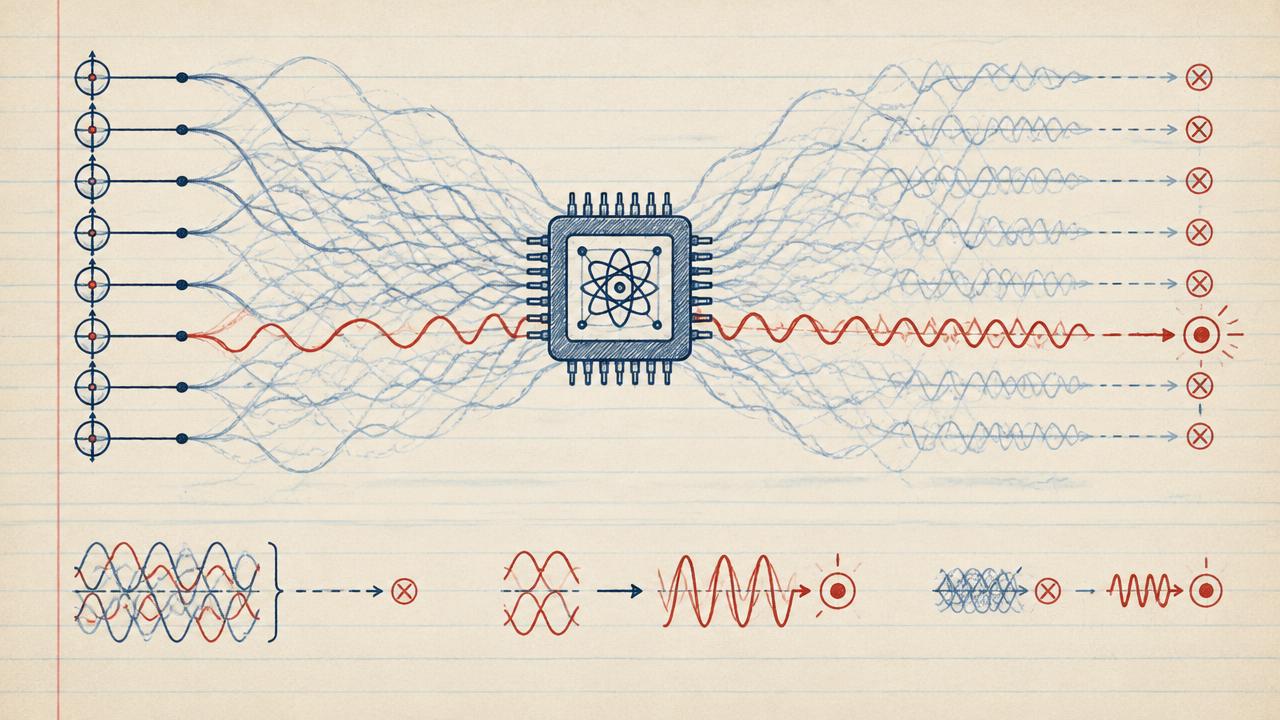
The popular picture is a Doctor Strange-like machine that checks every possible answer simultaneously and picks the right one. It is a tempting idea, because a quantum computer really can hold a superposition of many possible answers at the same time. The difference between fiction and reality is what happens next. When you measure, you get a single outcome, chosen by chance, so a computer that just ‘tried everything’ would hand you a random answer.
What makes a quantum algorithm work is interference. Each possible answer carries an amplitude, and amplitudes can cancel or reinforce each other, much like ripples on a pond. A well-designed algorithm arranges things so that the amplitudes of wrong answers cancel out while the amplitude of the right one builds up, so that when you finally measure, the right answer is very likely to appear. Grover’s search algorithm is the classic example: to search an unsorted list of a million items, a classical computer needs about half a million checks on average, while Grover’s algorithm needs in the order of a thousand steps. That is a huge speed-up, but it is not instant, and it is not ‘everything at once’.
Verdict: A quantum computer does not try every answer. It arranges the maths so that the wrong ones cancel out.
02. ‘Entanglement lets you send messages faster than light’: Busted
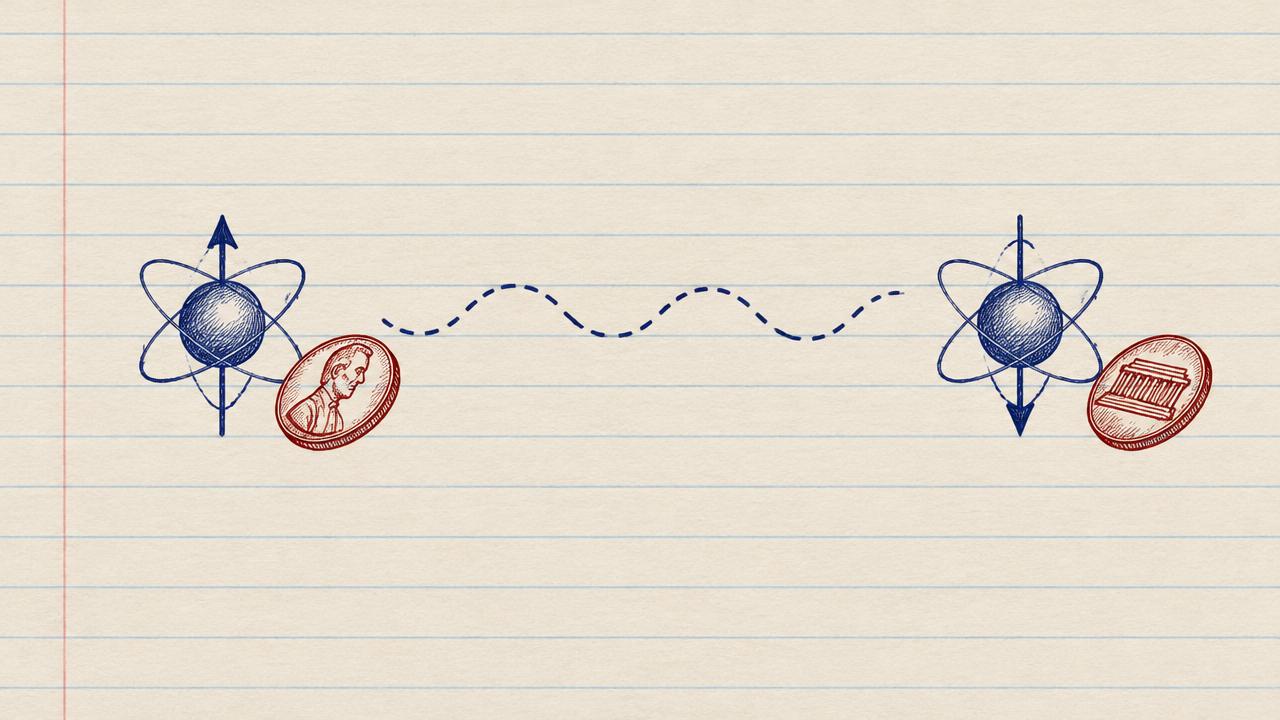
Start with what is real, because it is strange enough. When two particles are entangled, measuring one gives a result perfectly correlated with the other, however far apart they are. Einstein disliked this, and suspected the outcomes were fixed in advance by hidden information. Experiments testing a result called Bell’s inequality have since ruled that out: the outcomes really are not predetermined.
But the correlation cannot carry a message. On its own, each particle’s result looks like a fair coin flip, completely random, and you cannot choose which result you get, so you cannot encode anything in it. The correlation only appears when you and the other person compare your results by an ordinary method, which is limited by the speed of light. It is like two people each flipping a coin that always happens to match the other’s: neither can use their own coin to say anything. That captures why no message gets through, though not why it is strange. The strangeness is that the outcomes were never decided in advance.
Verdict: Entanglement is real and genuinely strange, but it cannot carry a message.
03. ‘Quantum teleportation is real’: Confirmed, with a twist
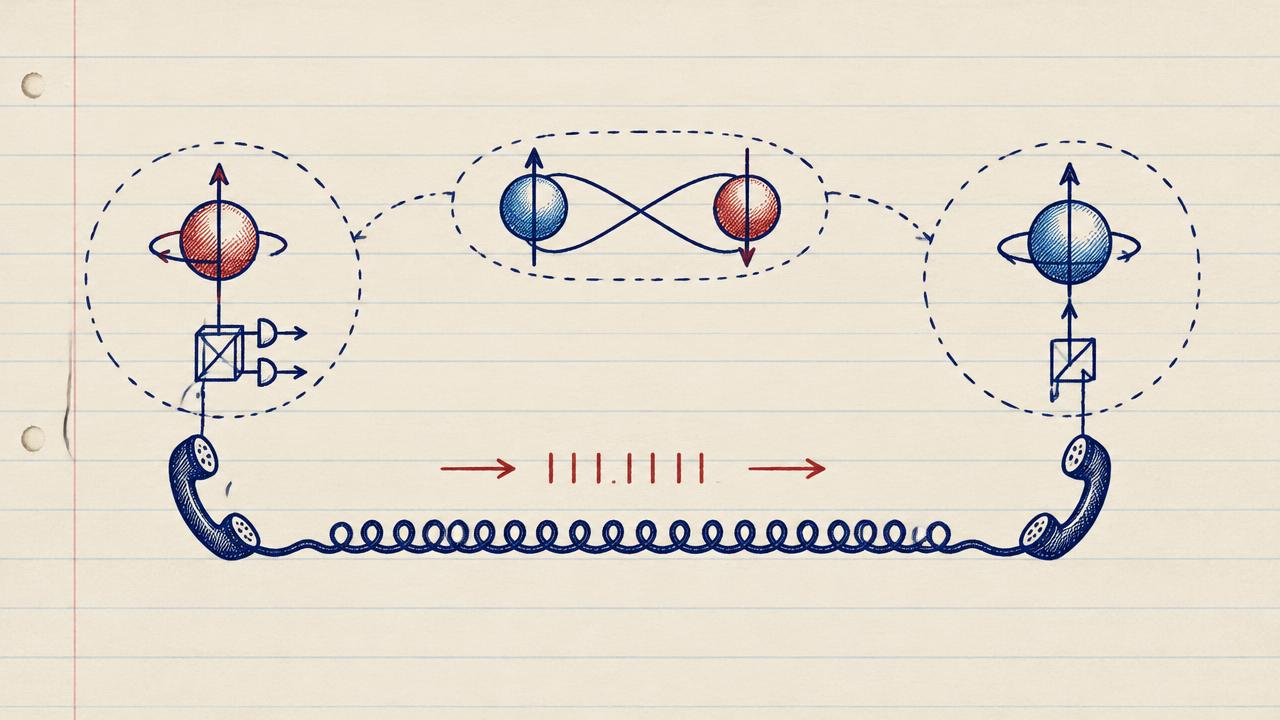
It is, and it has been demonstrated in laboratories since the late 1990s. But the name is misleading, because what moves is not an object. Quantum teleportation transfers the state of one particle onto another particle somewhere else, and the original loses that state in the process.
It works by using a shared entangled pair. The sender measures their particle together with their half of the pair, which destroys the original state, and sends the result to the receiver by an ordinary channel, such as a phone line or a fibre. The receiver uses that message to adjust their half of the pair so that it matches the original. Without the ordinary message, the receiver’s particle is useless, so nothing travels faster than light, and nothing is beamed anywhere.
Verdict: Confirmed, but it moves a state, not an object, and it still needs an ordinary message.
04. ‘Looking at a quantum system changes it’: Half true
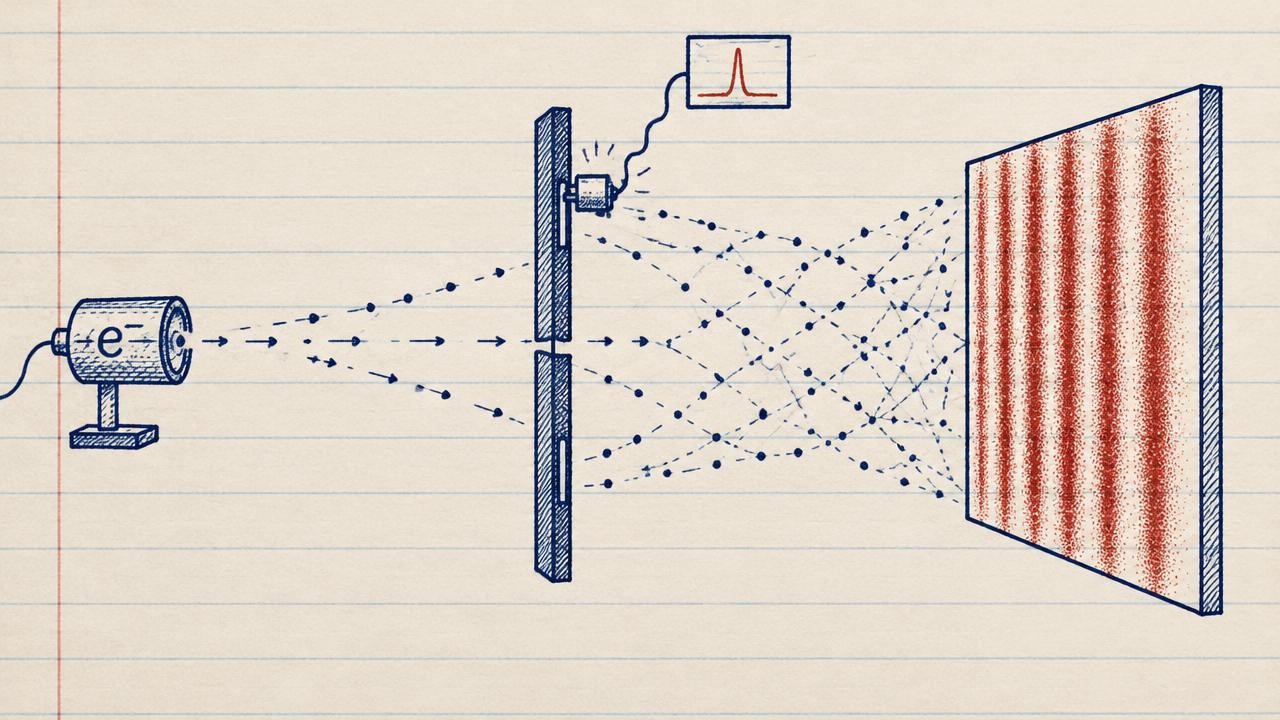
The true half is that measuring a quantum system really does change it. In the double-slit experiment, electrons fired at two narrow gaps build up a striped interference pattern, as if each one had gone through both gaps. Add a device that records which gap each electron passes through, and the stripes disappear.
The false half is the idea that a person has to be looking. In physics, ‘measurement’ means any interaction that records the outcome, whether that is a detector, a stray particle or a bounced photon. The stripes vanish because of the detector, whether or not anyone ever reads its display. Schrödinger’s cat is often blamed for the confusion, but he invented it as a criticism, to show how absurd it would be if superposition applied to everyday objects. A cat is constantly colliding with air and light, which wipes out any superposition almost instantly, long before anyone opens the box. What physicists still argue about is what collapse really is and why it happens, but not whether you need a conscious mind for it.
Verdict: Looking doesn’t change reality. Interacting with it does, and anything can do that, not just a person.
05. ‘Quantum computers will be faster at everything’: Busted
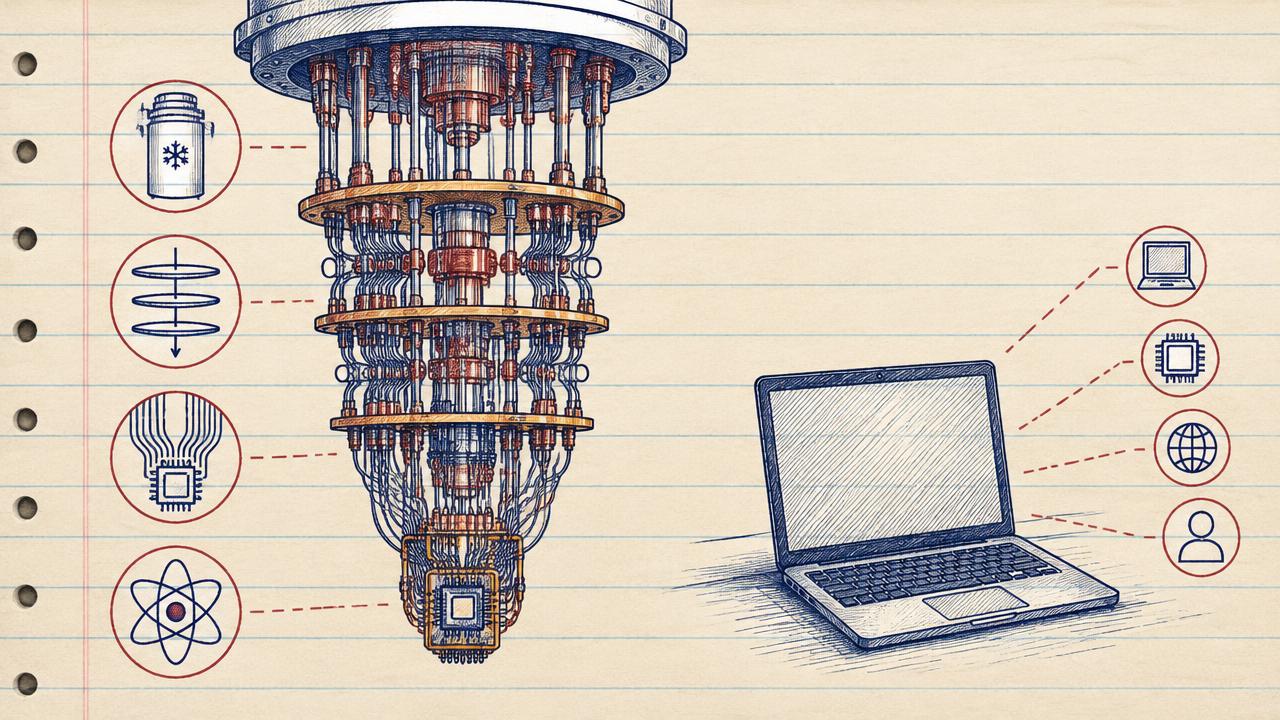
Quantum computers are only expected to help with certain kinds of problem. The best-known examples are factoring very large numbers, searching unstructured data and simulating quantum systems such as molecules and materials. For ordinary tasks, like browsing, spreadsheets or games, they offer nothing, and a normal computer would do the job better and far more cheaply.
A quantum computer is closer to a wind tunnel than to a better workshop: astonishing at one kind of job, and pointless for most others.
Verdict: Quantum computers will be specialists, not replacements for your laptop.
06. ‘Quantum computers will break all encryption’: Half true
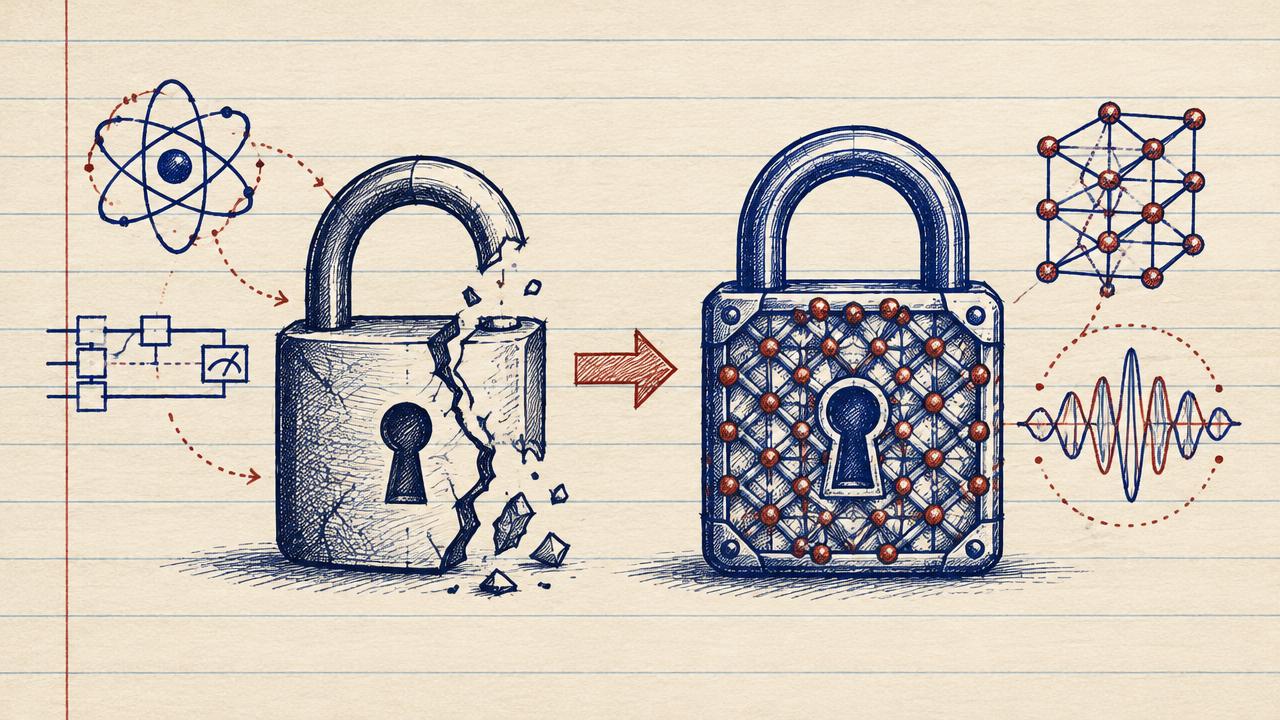
The true half is Shor’s algorithm. A large enough quantum computer could use it to factor big numbers efficiently, which would undermine widely used public-key encryption such as RSA, because that security relies on factoring being extremely hard. There is a real concern that data intercepted today could be stored and decrypted later.
The other half is why ‘all’ is wrong. Running Shor’s algorithm at that scale needs a large machine with error correction, and no machine built so far is close to it. New quantum-resistant encryption methods have already been standardised and are being rolled out. And for the type of encryption used to protect data in transit and at rest, Grover’s algorithm only weakens it modestly, which a longer key can fix.
Verdict: Some encryption is at risk, not all, and the defence is already being built.
The pattern across all of these is the same. The physics is real, but the headline version skips the part where something has to be carefully arranged, measured or shared the ordinary way. Quantum isn’t magic. It is a strict set of rules, and that is far more interesting.